Colorado, 1885. Some people arrive in a town looking like they belong there. Eliza Marsh was not one of them. She was sitting on the front steps of the Clearfield Hotel on a Tuesday afternoon in October with a single leather bag beside her and the expression of someone who has run out of options and is not yet ready to admit it. Her hair was coming loose from its pins.
Her beige linen dress, travel-worn, had seen better days and better weeks. She had come from Tennessee to join her uncle, the last family she had. He had written her in January, “Come west,” he’d said, “There is room here. There is a life worth building.”
She had packed everything she owned into the leather bag, sold the rest, and boarded a train going west. Her uncle had died 2 weeks before she arrived, pneumonia, quick at the end. He had left nothing behind except an unfiled claim and a small debt at the general store. She had nowhere to go back to. She had nothing to go back to.
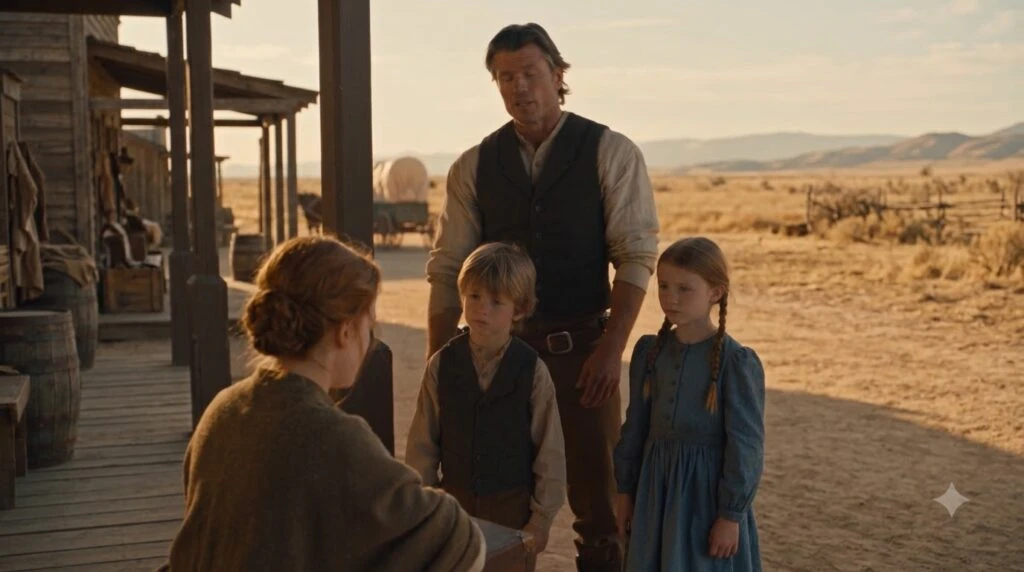
So, she sat on the hotel steps in Clearfield, Colorado, doing the arithmetic of a life that had run out of numbers. It was then that a boy of about nine stopped directly in front of her, looked at her with the direct gaze of a child who has not yet learned that staring is impolite, and said, “Why are you sad?” And before she could answer, a man’s voice said, “Owen.” And she looked up. The man was tall, dark-haired with gray at the temples, wearing a dark waistcoat over a linen shirt with the sleeves rolled to the elbow.
He had the look of someone who works outdoors and has stopped noticing it. He was holding a list and a package from the general store, and he gave Owen a look that had worn a groove into both of them. The same look, probably, for 3 years running. “Owen,” he said again. “She looks sad, Papa,” the boy said without moving.
“People are allowed to be sad,” the man said. “It’s not our business.” “But we could make it our business,” Owen said. The younger girl, with a dark braid, said nothing and watched everything. She had stopped walking and was looking at Eliza with the steady attention of someone who takes in more than she gives back.
Eliza looked at the three of them. “I’m all right,” she said. It was not true, but it was the most available answer. The man looked at her the way a rancher looks at weather, reading what’s actually there, not what he’d prefer to find. “Daniel Holt,” he said.
He shifted the package to his left hand and extended his right. “This is Owen. That’s Lucy.” “Eliza Marsh,” she said and shook his hand. “You’re not from Clearfield,” he said.
“Tennessee,” she said. “I came to find my uncle.” Something shifted in his face. Not pity, something quieter. The recognition of a man who knows what it is to have something not be where you expected it.
“Did you find him?” he said. She looked at the street. “He died before I arrived,” she said. Owen had stopped fidgeting. Lucy had moved slightly closer to her father’s side.
“I’m sorry,” Daniel Holt said. And he meant it. She could hear the weight of it, the difference between condolence spoken by someone who has also lost something real and condolence spoken by someone who has not. “Is there somewhere you’re staying?” he said. She looked at the hotel behind her, then back at him.
“I’m working on that,” she said. She had $4.30. The hotel cost $2 a night. She had enough for two nights, which gave her two days to find work. Not impossible, but close enough to impossible that the distinction felt academic.
She had not told Daniel Holt any of this.
She spent the afternoon doing what she could. The general store needed no one. The restaurant was fully staffed. The schoolhouse already had a teacher. The laundry at the edge of town was a possibility.
The woman who ran it, a Mrs. Pierce, said she might have work next week, not this week, and looked at Eliza’s hands with the assessment of someone measuring the difference between a woman who had done laundry and a woman who hadn’t. Eliza had done laundry. She had done most things. She had run her family’s house since she was 14, after her mother died.
Cooking, mending, accounts, the endless practical management of a life without anyone ever asking if she wanted to be the one doing it. She was back in her room doing the arithmetic again when there was a knock at the door. She opened it. Owen Holt was standing in the hallway holding a covered dish. “Papa made stew,” he said.











