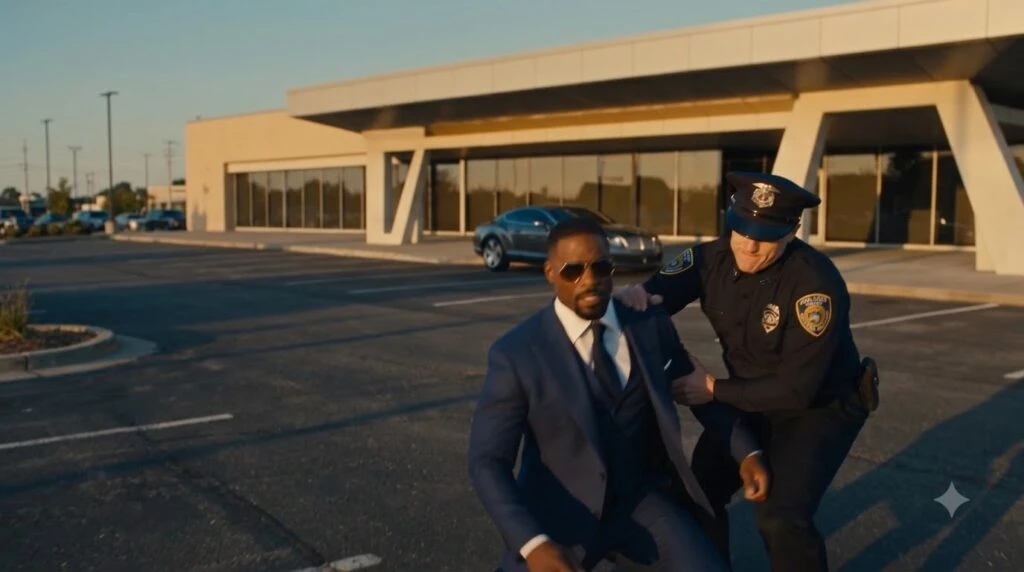
“Get out. Now.”
“Sir, I just need to make—”
“Did I say you could speak? Shut your mouth before I make you regret opening it.”
“I have an executive credential.”
Carl Whitman spat near his shoes.
“An executive credential? Yeah, and I’m the Pope. Forty years old, dressed like you own the place. On your knees. Face on the ground. Now.”
His boot slammed into the man’s spine.
Mirrored sunglasses shattered across the asphalt.
A fourteen-thousand-dollar suit ground into dirt.
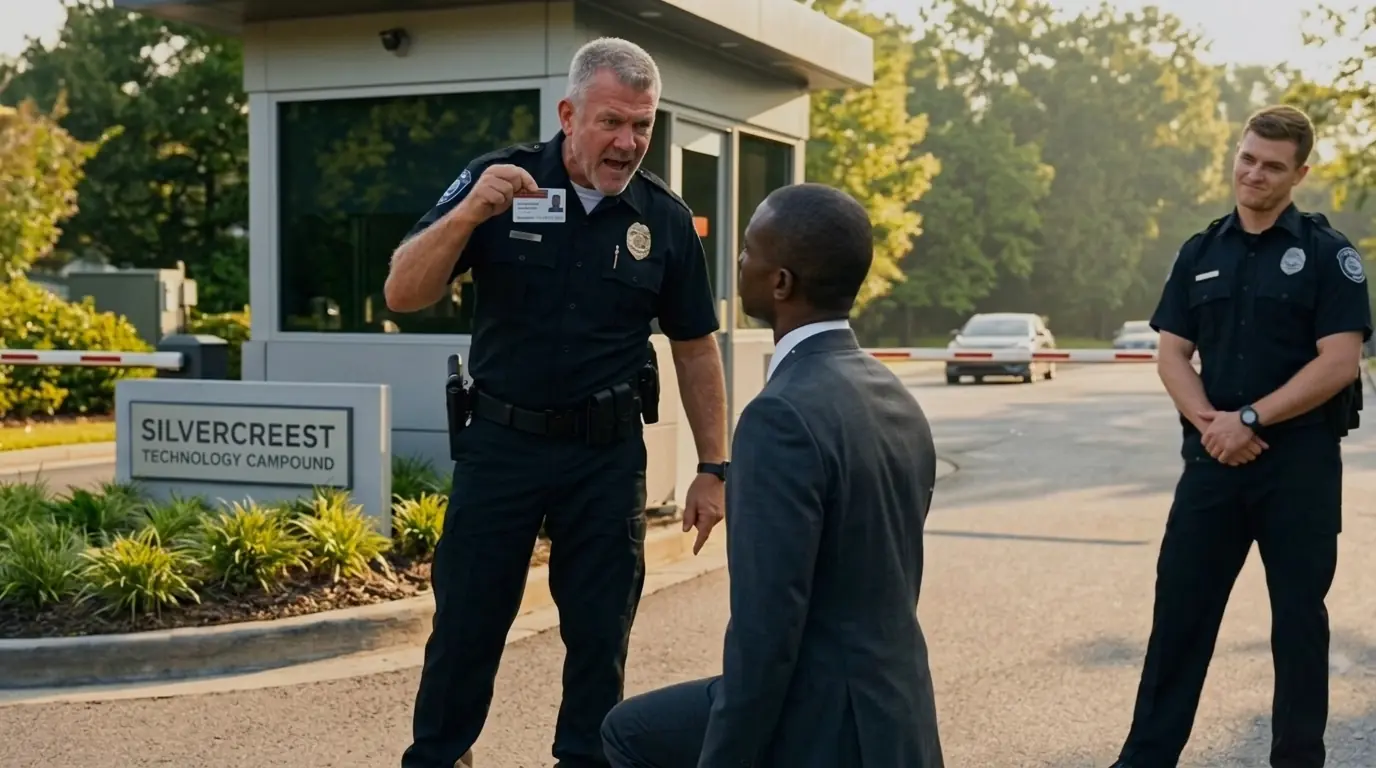
The man did not resist.
He did not shout.
He just smiled softly, almost pitying.
Because what this guard had not realized yet was whose property he was standing on.
And within twenty minutes, that smile was going to cost him everything he had ever built.
Three hours earlier, the sun had not yet crossed the Georgia horizon.
In a quiet kitchen in Buckhead, Atlanta, Andrew Whitaker poured his first coffee of the day.
The steam curled in the pre-dawn light. A grandfather clock ticked softly from the hallway. Somewhere outside, a mockingbird practiced its morning scales.
Andrew was forty years old, tall, lean, and quiet in the way only a man becomes after surviving a lot.
On the marble counter, three photographs formed a small altar.
His wife, Claire, laughing on a beach in Santorini.
His two daughters, Lily, eleven, and little Emma, six, holding hands at a piano recital.
And framed in tarnished brass, a handwritten letter from his late mother, Eleanor Whitaker, dated the summer before she died.
“Baby,” she had written, “you belong wherever you stand. Don’t let anybody ever tell you different.”
Andrew read those words almost every morning.
He did not need to look at the paper anymore.
The ink had settled into his bones.
He set his mug down and pulled up a holographic projection of the Silvercrest Technology campus on his kitchen counter.
Four hundred acres.
Twelve buildings.
Three thousand two hundred employees.
A biotech and AI compound he had built from nothing over fourteen years.
Starting with a rented garage in Ohio and ending here in the beating heart of the new South.
Today, he would inspect the East Wing personally.
No driver.
No entourage.
No warning.
His private quarterly ritual.
Arrive anonymous, see the company the way an employee sees it.
Or better yet, the way a stranger sees it.
The coffee was still warm when he walked out to the garage.
His Bentley Flying Spur sat in matte black, breathing faint morning mist.
He adjusted his Brioni jacket, slipped on his mirrored aviators, and drove into the rising Georgia sun.
The campus was forty-three miles north in Alpharetta.
He took the scenic route.
Radio off.
Window cracked.
The smell of Georgia pine filling the cabin like incense.
For a while, it was just him, the road, and the memory of his father.
Theodore Whitaker, who had died in a warehouse accident when Andrew was nineteen.
His father never saw any of this.
Never saw the buildings.
Never saw the billionaire status.
Never even saw the grandkids.
Andrew whispered the same three words he always did when he passed mile marker twenty-two.
“Still here, Dad.”
By 8:14 a.m., the Silvercrest main gate rose out of the trees.
The campus looked like something from a magazine.
Manicured lawns.
Solar panel canopies.
A fountain sculpted to resemble interlocking neurons.
The American flag and the Whitaker Industries flag rippling side by side in the October breeze.
Andrew slowed as he approached the north gate.
He had been told a new security contractor had taken over three months ago.
Blackthorn Protective Services.
He had not met them yet.
And that was exactly the point of today.
Behind the guard booth, through the tinted glass, he could see movement.
A figure in a black uniform.
Crew cut.
Broad shoulders.
An American flag pin on the lapel.
A “Don’t Tread on Me” decal glaring from the window.
The figure looked up as the Bentley rolled to a stop.
The man’s expression shifted instantly.
Not recognition.
Suspicion.
Contempt.
A second guard appeared, younger, nervous.
A third jogged up behind, hand already drifting toward his holster.
Andrew took a slow, measured breath.
He rolled down the window and smiled politely, ready to swipe his executive credential.
What he did not know yet, what none of them knew yet, was that twenty-three minutes from this moment, a cell phone camera belonging to a junior engineer named Maya Harlow would begin recording.
That recording would eventually be viewed forty million times in forty-eight hours.
It would trigger a federal investigation, a state law, and the collapse of a billion-dollar security conglomerate.
But for now, the morning was still gentle.
The October air still smelled like cut grass and diesel.
The head guard stepped out of the booth.











