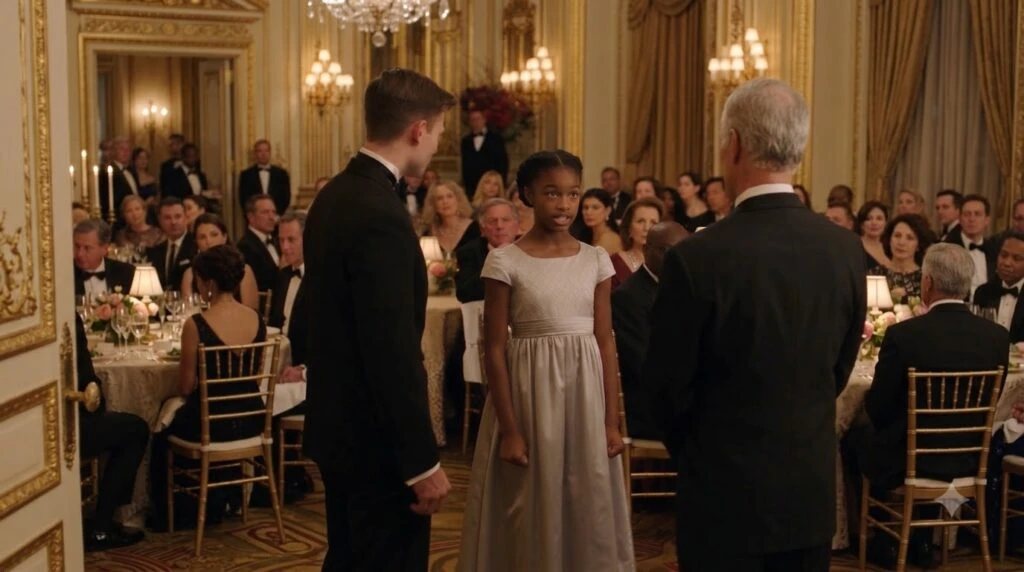
“Play the violin, girl. Do that, and maybe, just maybe, I’ll consider adopting you.” “Sir, please.” “I’m just asking for a chance to study music.” “You hear that, gentlemen?”
“She wants to study music.” “Black girls like you don’t study music.” “Girls like you serve coffee to people who do.” 300 guests heard it. Nobody moved.

Harper Langston was 15, black, an orphan, and she had not come to that ballroom to leave the way they expected her to. What she did next made a $400 million man wish he had stayed silent. To understand what Harper Langston did in that ballroom, you have to go back six hours and then seven years before that. Six hours earlier, she was sitting on the edge of a narrow bed in Brooklyn holding a wooden metronome in both hands like it was breakable. “Harper, honey, the van leaves in 20 minutes.”
Sister Margaret’s voice carried up the back stairs. Harper didn’t answer. “Harper? You hear me, child?” “Yes, Sister.”
“Then come down. I am not driving to Manhattan with a dress in one hand and no girl in it.” Harper almost smiled. Almost. Saint Cecilia’s Home for Boys and Girls had stood on that corner of Brooklyn since 1962.
Bricks the color of dried blood, ivy frozen on the upper windows. Inside, the hallway smelled of old hymnals, cabbage soup, and the wax Sister Margaret applied to the floors every Saturday whether the floors needed it or not. There were 38 children at Saint Cecilia’s that fall. Harper was the oldest girl. In 9 months, on her 16th birthday, she would age out, transferred to a group facility in Albany, 300 miles upstate, where there was no music program of any kind.
She had not told anyone she knew this, but she knew. Two weeks earlier, she had asked Sister Margaret about it at the kitchen sink. “Sister, is there a piano in Albany?” Sister Margaret had been washing a coffee cup. She had not looked up.
“Harper, don’t ask me that.” “I just want to know.” “And I just told you. Don’t ask me that, child.” “Sister, please.”
“Harper Langston, hand me that dish towel and stop talking.” That was when Harper had understood there was no piano in Albany. Harper had been good at exactly one thing in her life since she was 5 years old. She could play piano. Not the way other children played.
She could play the way her mother had played. Her mother had been Imani Langston, a piano teacher in Harlem, a woman with long fingers and a quiet voice. Harper still remembered the apartment on 125th Street, the radiator that hissed, the upright that took up most of the living room, the way her mother used to sit beside her on the bench and not say anything for whole minutes. “Try the chord again, baby.” “I did, Mama.
It sounded wrong.” “It sounded wrong because you were waiting for me to fix it. Don’t wait.” “Try again.” “What if I keep getting it wrong?”
“Then you keep trying. That’s how the music finds you.” Imani never raised her voice. She didn’t have to. The last thing Imani had ever said to Harper about music had come from a bed propped up on pillows, voice thinned by fever.
“Baby, listen to me.” “I’m listening, Mama.” “When folks tell you what you can’t do, you sit down at what you can. You hear me?” “Yes, Mama.”
“Say it back to me.” “I sit down at what I can.” “Again.” “I sit down at what I can.” “That’s my girl.
Don’t ever forget that.” She had died 3 days later. The hospital had been three blocks from the apartment. They had not gone. The bill, Amani had told her sister on the phone the week before, would have cost more than they could pay in a year.
Harper had inherited two things from her mother. The wooden metronome she was holding now, and a notebook of half-finished compositions written in pencil, the staves drawn by hand because Amani had never been able to afford the printed kind. There was a piano at St. Cecilia’s, an upright Yamaha donated 30 years ago. Three of the keys stuck.
The middle pedal was broken. It lived in the chapel at the back of the building. Every night after curfew, Harper crept down the back staircase in her socks and played it for an hour by the light of one candle. Sister Margaret had known about the piano nights for years. She had never said a word.
Not until Harper’s 14th birthday, when she had pressed a fresh candle into Harper’s hand at the chapel door. Harper, yes, Sister? “The world doesn’t ask permission to give you a gift.” “Sister, I—” “So don’t ask permission to use it.” “You go on.”
“Light your candle. Play until your hands hurt.” “Yes, Sister.” “And Harper?” “Yes?”











