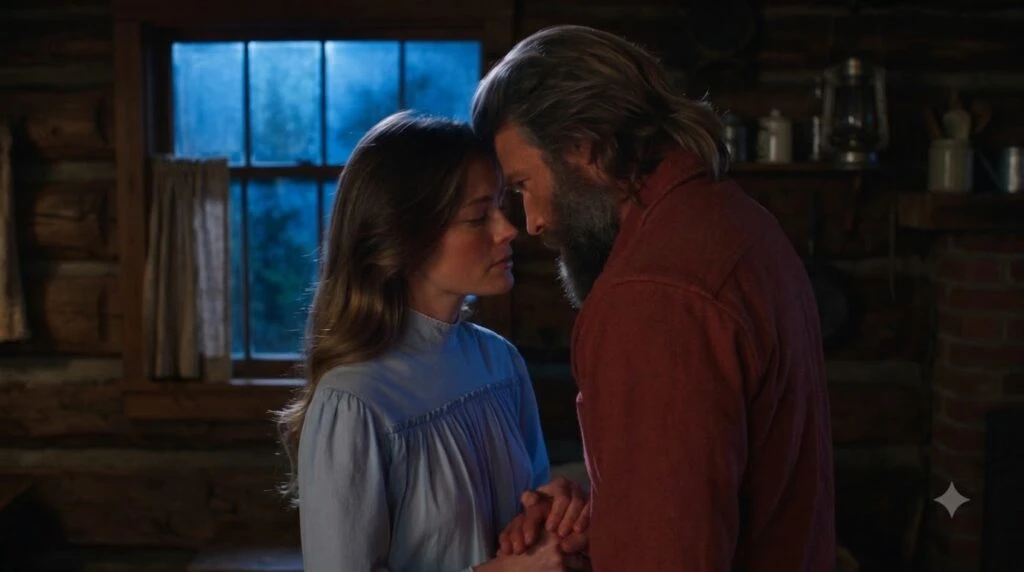
The storm had come down off the Big Snowy Mountains a little after supper, and by nine o’clock it owned the whole of the Judith Basin. It came in long shoulders of wind that leaned against the cabin and then let go, so that the log walls seemed to breathe in and out. Sleet ticked at the one glass window. The stovepipe moaned. Inside, the iron stove glowed a deep cherry red at its seams, and the coal-oil lamp on the table threw a round of yellow light that did not quite reach the corners, where the shadows sat like patient animals.
There were real animals too. Three dogs lay in a heap near the stove: old Deacon, a gray-muzzled bloodhound mix with ears like wet dishrags, and the two young ones, Juno and Pike, big rough-coated shepherd crosses that Ethan had raised from a litter born in his barn. Every time the wind hit the door, Pike lifted his head, considered the matter, and laid it down again.
Clara Whitmore stood near the foot of the bed with the lamplight behind her. She was twenty-nine years old and had been a widow for two years and a wife again for six weeks, and in all that time she had never once stood in a room with a man and felt that the next minute belonged to her. She felt it now. It made her a little dizzy.
Her hair was loose. It was a dark honey-blonde, the color of clover honey held up to a window, and it fell in a heavy, faintly waving curtain past her shoulder blades. She had brushed it out a hundred strokes before bed, the way her mother had taught her, and in the lamplight it had a low shine to it, gold on the crowns of the waves and something nearer to brown in the hollows. She wore a high-necked nightdress of pale blue lawn, buttoned to the throat with a row of small pearl buttons and gathered at the wrists, plain and modest and so soft from washing that it moved when she breathed. Her face was a fine oval, with a clear, fair complexion that the summer had dusted faintly gold across the nose. Her brows were a shade darker than her hair and naturally well shaped, arching cleanly over wide eyes of a gray-green that turned nearly hazel by lamplight. Her lashes were thick and dark for a fair woman, so that her eyes looked always as though they had been lined with a careful hand, though she had never owned a pot of anything in her life but cold cream. There was a natural flush high on her cheeks from the heat of the stove, and her mouth was full and soft and rosy, the lower lip a little fuller than the upper, the kind of mouth that seemed about to smile even when it was not.
She was looking across the room at her husband.
Ethan Calder stood with his back flat against the log wall beside the window, his palms pressed to the wood on either side of him as though the cabin might fall down if he let go. He was six feet and five inches tall, and the cabin, which he had built himself and built generously, seemed nonetheless to have been made for a smaller man. His head was not far from the ridgepole. His shoulders took up a good part of the wall. He wore a red flannel shirt, faded at the elbows and buttoned to the collar, with the sleeves turned back once over forearms like fence posts. His hair was dark brown and wavy and grew past his ears, because he cut it himself only when it got into his eyes. His beard was thick and dark brown too, and at the chin and along the jaw it had begun, at thirty-three, to come in with threads of early gray, as though frost had settled there and decided to stay. Above it, his eyes were gray, the clear soft gray of woodsmoke, and they were fixed on her with an expression she had seen once before, on a yearling colt the first time it was led into a lighted barn.
His hands, flat against the wall, were scarred. There was a white seam across the back of the left one where a strand of barbed wire had whipped loose, and the knuckles of the right were knotted and pale with old rope burns. She had watched those hands set a dog’s broken foreleg so gently that the dog had licked his wrist the whole time.
“Ethan,” she said, “why are you pressed against the wall?”
He swallowed. She watched it move in his throat above the collar of the red flannel. The wind leaned on the cabin and let go.











