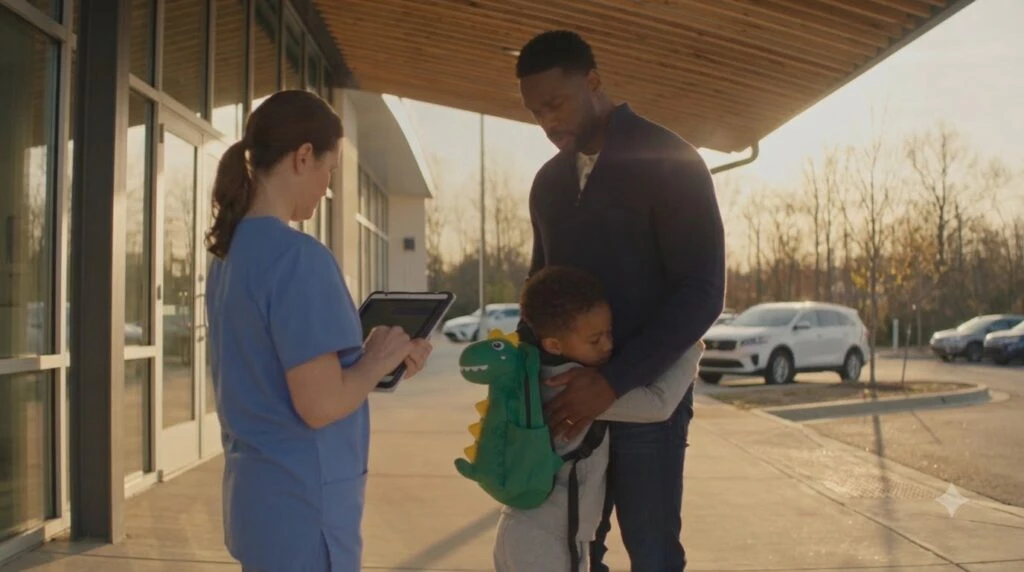
The light at Bright Oaks Early Learning Center always arrived late in the afternoon as if it had been waiting all day to be noticed. It came slanting across the parking lot from the west, over the pine break that separated the center from the Falls of Neuse traffic, and it landed on the long covered walkway in pale gold bars, one between each steel post. By a quarter past five the bars had stretched halfway to the glass doors, and the parents who walked through them looked briefly lit from within, like people in a commercial for something they could not afford.
Marcus Hill parked his gray Highlander in the third row, between a white Tahoe with a stick-figure family on the back window and a Volvo whose driver was still on a call, mouthing yes, yes, I understand, through the windshield. He cut the engine and sat for a moment with his hands on the wheel. It was a Thursday. He had not been here on a Thursday in almost three weeks, and the strangeness of that made him feel like a man arriving at his own house through the back door.
He was thirty-eight and still built like the sprinter he had been at nineteen, tall and long through the legs, with shoulders that filled the charcoal zip jacket he wore over a white polo. His jeans were clean because he had changed out of his site clothes in the trailer at the Brier Creek job before he left. His hair was cut short in waves, and his beard was trimmed close along a jaw that his wife said made him look serious even when he was laughing. His eyes were dark and, lately, heavy at the lids, though he would not have said so. He told himself it was the light.
The Brier Creek owners’ meeting had been canceled at two-thirty with a single line of email, and for a moment he had stared at the screen with the disoriented feeling of a man who has been handed an hour he did not earn. Tiana had the Thursday pickups now. She had said so herself, three weeks ago, standing at the kitchen island with her coffee: they’d moved her to an early shift two days a week at the hospital pharmacy, she could get Noah on Tuesdays and Thursdays, and Marcus could stop leaving the job site at four like he was sneaking out of class. You look exhausted, she had said. Take the two days. Go home and lie down for once.
He had not gone home and lain down. He had worked later on those days, because that was what a project manager did with time that fell into his lap. But today the hour was too clean to waste, and he had thought, without quite deciding, that he would surprise them both. He would be standing at the glass doors when Tiana pulled in. He would have Noah already on his shoulders. It would be a small, good thing.
He got out of the car. Around him the pickup hour was moving the way it always moved, with a choreography no one had designed and everyone knew. A mother in scrubs carried a sleeping toddler against her shoulder, the child’s tiny backpack, shaped like a ladybug, swinging from her own elbow. A father in a Carolina Hurricanes cap jogged back toward the building because he had forgotten a lunchbox. Two little girls in matching rain boots, though it had not rained in a week, walked hand in hand toward a minivan whose sliding door was already opening on its own. SUV doors thudded. Somewhere a car seat buckle clicked, and a child protested, and a parent said, in the voice of the deeply tired, I know, baby, I know.
Under the covered walkway, near the glass entrance, the teachers stood in their navy Bright Oaks fleeces with clipboards and tablets, calling names over their shoulders into the bright interior of the building. Marcus recognized Ms. Celeste Moreno, Noah’s lead teacher in the Acorn Room, a compact woman in her forties with reading glasses pushed up into graying black hair and a lanyard heavy with keys. She was the kind of teacher who knew which child would cry if you cut his sandwich in triangles instead of squares. Noah adored her. Marcus lifted a hand, and she smiled at him, and then something passed over her face, a small hitch, as if she had turned a page and found it out of order.
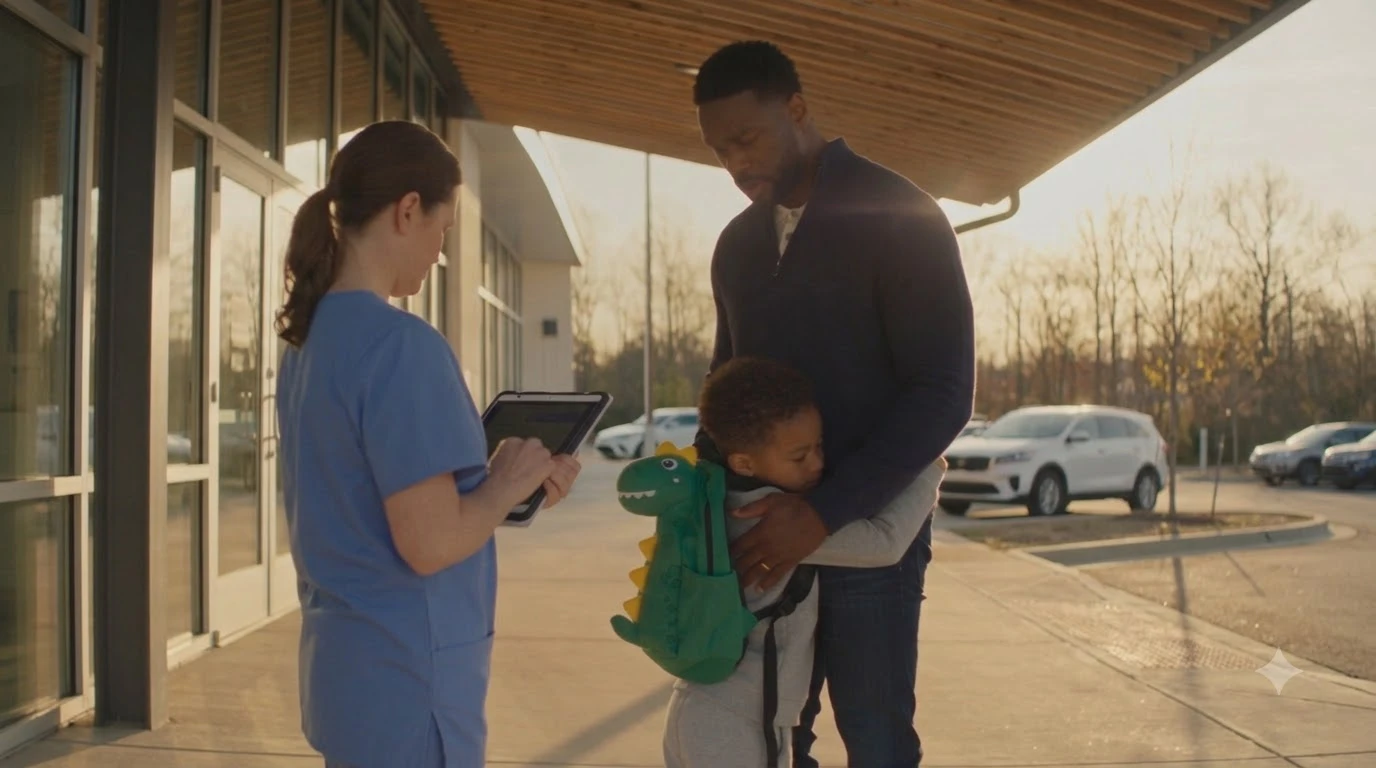
He did not have time to think about it, because the glass doors swung open and Noah came through them running.
He was five, and he ran the way five-year-olds run, with his whole body committed and none of it coordinated. His medium-brown skin was flushed at the cheeks. His short curls had a bit of something glittery caught in them, the residue of an art project. The green dinosaur backpack bounced against his spine, its little felt spikes flopping, its stuffed tail slapping the backs of his gray joggers. His blue sneakers, the ones that lit up at the heel, flashed red with every step. He did not slow down when he reached his father. He hit Marcus at the waist and wrapped both arms around him and held on, and he pressed his face into the charcoal jacket so hard that Marcus felt the bridge of his small nose against his belt.











