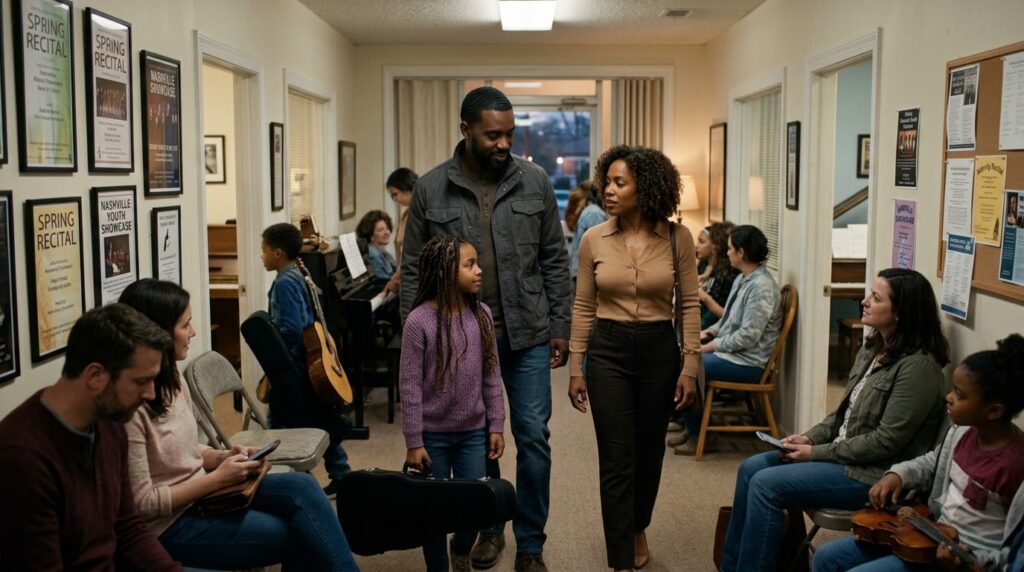
The changeover at Cumberland Strings & Keys happened every weekday at ten minutes to six, and for those eight or nine minutes the narrow hallway of the converted dentist’s office turned into a kind of weather. Cello cases knocked against the drywall. A boy with a trumpet case the size of a carry-on bag tried to get past a grandmother holding a toddler on her hip. Somebody’s younger brother had found the bowl of peppermints on the front desk and was methodically emptying it into the pocket of his hoodie. From behind the closed door of Studio B came the last stubborn bars of a piano scale, up and down and up again, while a mother in scrubs scrolled her phone and muttered to nobody in particular that Patrick could let the poor girl go now, it was six o’clock.
Brian Carter stood against the wall beneath a recital poster that had been there so long its corners had curled into little tubes. SPRING SHOWCASE, it said, in a font made to look like music notes. SATURDAY, MAY 16. ALL STUDENTS WELCOME. Below it someone had pinned a newer, laminated sign that read PLEASE DO NOT LEAVE INSTRUMENT CASES IN THE HALLWAY, which every family in the building was currently ignoring.
He was still in his dark gray work jacket, the one with the company patch over the heart and a faint ring of dried caulk on the cuff he kept meaning to scrub out. He had not been inside the school on a weekday evening in months. On Saturdays, sure. On Saturdays he sat in the folding chairs for group class and watched twelve children try to play Lightly Row in something like unison. But his Tuesday-through-Thursday shift had moved to eleven-to-eight back in February, and the job in Hermitage that was supposed to eat the rest of his afternoon had cancelled at three-thirty because the building manager couldn’t find the key to the mechanical room. Brian had sat in the truck in that parking lot for a full minute with the engine running, realizing that for once he could just go. Not home. Here. He could surprise her.
The door to Studio C opened, and Kayla came out with her violin case held in front of her in both arms like a tray of something hot.
She was nine, and she was wearing the purple sweater her grandmother had sent from Memphis at Christmas, a size too big so she’d grow into it, the sleeves pushed up past her wrists. Her braids were done in two thick ropes that her mother had redone on Sunday night, and there were little clear beads at the ends that clicked when she turned her head. She turned her head now, scanning the hallway the way she did, chin up, eyes going past the trumpet boy and the grandmother and the woman in scrubs—and then they found her father, and her whole face changed. It opened. Then, almost as quickly, it did something else. It went toward the glass front door and the parking lot beyond it, searching.
She came to him through the crowd, the case bumping knees, and when she reached him she didn’t hug him first. She looked past his elbow at the door.
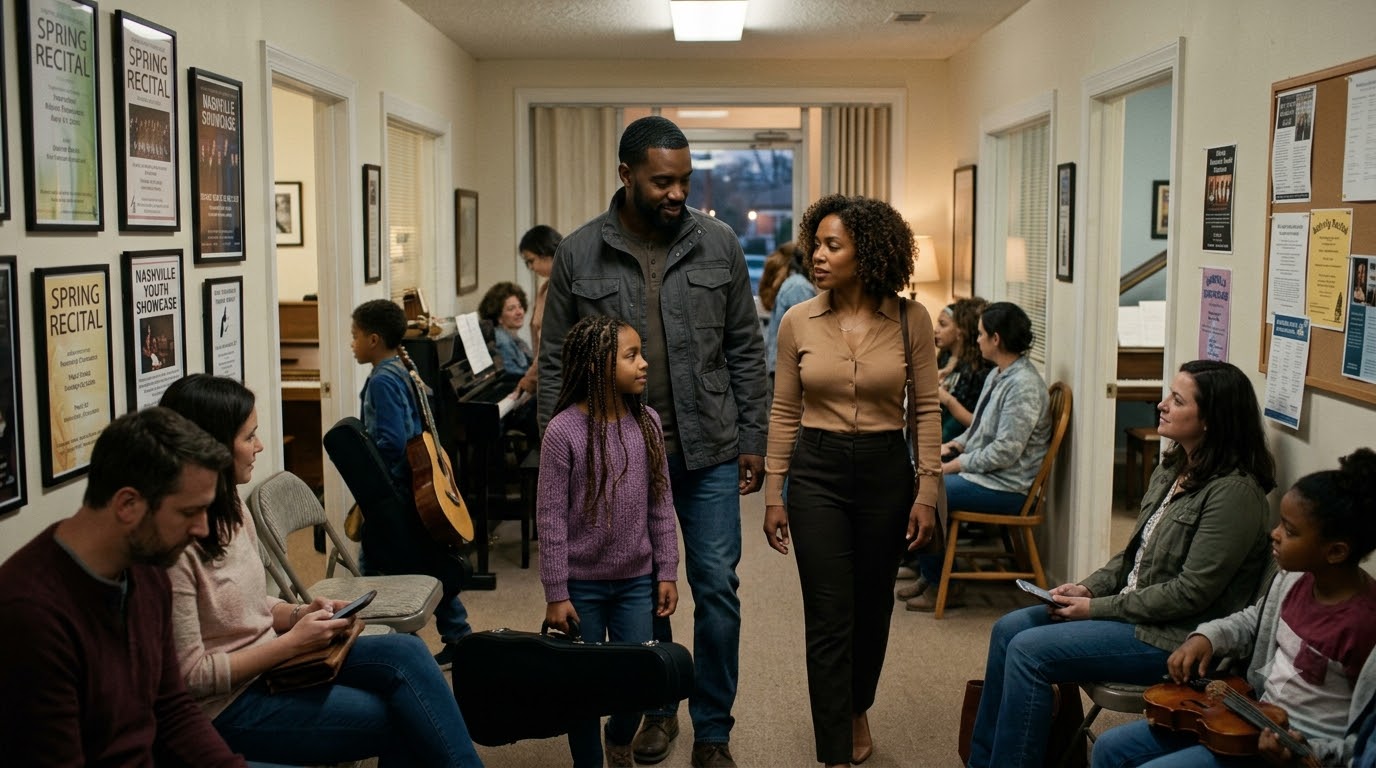
“Dad, is Mom’s friend outside?”
Brian smiled at her, because he didn’t understand the question yet, and because she had a smear of rosin dust on her chin like powdered sugar, and because he had been looking forward to the look on her face all the way down Old Hickory Boulevard. He reached out and thumbed the dust away.
“What friend?”
Behind Kayla, the violin teacher had stepped into the doorway of Studio C. Lorraine Haskins was somewhere north of sixty, a tall, thin white woman with silver hair cut short as a boy’s and reading glasses on a beaded chain, and she had been teaching strings in this part of Nashville since before Brian was out of high school. Kayla adored her. Kayla said Miss Lorraine could tell from across the room if your pinky was flat, which was apparently the worst thing a pinky could be. Miss Lorraine had one hand on the doorframe and a stack of photocopied sheet music in the other, and she was smiling at Brian in the friendly, slightly puzzled way people smile at someone they half recognize, a father she knew mostly from Saturdays, surprised to see him on a weekday. She glanced at the front door herself, helpfully, as if to save everyone time.
“The gentleman who usually gets her Thursdays.”
Brian’s hand was still on his daughter’s chin. He felt the hallway noise go on around him, the trumpet case, the piano scale, the peppermint wrappers, but it had gone thin, like a radio playing in another room.











