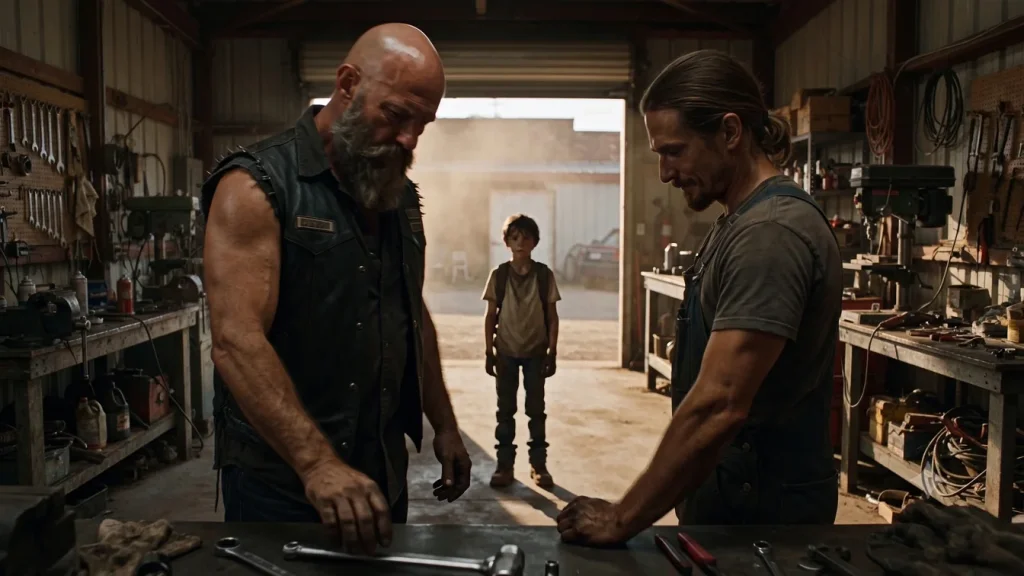
“I Can Make Her Run,” the Boy Said, Pointing at the Tarp Nobody Touched
The bell above the door of the Iron Horse garage had been broken since March. Nobody had fixed it, because nobody could agree whose job it was, and because the men who worked there had stopped needing to know when someone came in. Customers called first. Friends honked from the lot. Strangers did not come at all.
So when the boy pushed the door open on a gray Tuesday afternoon in late October, there was no sound. The hinge did not even creak. The wind came in around him, carrying a few dry leaves and the smell of the road, and then the door eased shut behind him, and he stood there in the doorway with the cold at his back.
Nobody looked up. He waited. He did not clear his throat or knock on the frame or say hello. He just stood, and counted, the way a person counts when he has rehearsed a moment so many times that the real thing feels like a copy of it.
One. Two. Three.
He was thirteen years old. He was thin in the way of boys who had grown two inches in a summer and had not yet been fed enough to catch up with it. His hair was dark brown and too long, falling across his forehead in a way that suggested nobody had told him to cut it in a while. His eyes were gray, set deep, older than the rest of his face. A canvas backpack hung from his left shoulder, faded green, with a strap that had been mended with black electrical tape. His jeans were clean but worn white at the knees. His boots were too big for him, brown leather work boots with the toes scuffed pale, laced as tight as they would go and still loose around his ankles.
His fingers were black with grease. Not smudged, the way a kid’s fingers get from touching a bicycle chain, but worked into, the grime pressed deep into the creases of his knuckles and packed under his nails, as though he had been elbow-deep in an engine that very morning and had come here straight from it.
Three men stood around a motorcycle in the middle of the shop floor. It was a Ridgeline Sprint, a lean little V-twin from the early nineties, and it was in pieces. The tank sat on a folded moving blanket. The primary cover was off. The front wheel leaned against a rolling toolbox, and the carburetor lay on a shop towel like a patient on a table.
The man nearest the door was bald. Not shaved, but bald the honest way, his scalp tanned and freckled and shining under the shop lights. He was somewhere past sixty, broad through the chest, with arms as thick as fence posts and forearms roped with old veins. His hands were wide and scarred, the knuckles flattened and knotted from decades of slipped wrenches and stubborn bolts. He wore a gray work shirt with the sleeves rolled to the elbow and a name stitched in red thread over the pocket, though the thread had worn so thin that the name could no longer be read.
He was the first to see the boy. He did not startle. He slowly lowered the torque wrench in his right hand until its head rested against his thigh, and he looked at the boy the way a man looks at a noise in an engine he has never heard before. Not alarmed. Just paying attention.
The other two men looked up a second later.
The garage was called Iron Horse. It stood on half an acre of cracked asphalt beside Route 912, eleven miles south of Corliss, a town most travelers passed through on their way to somewhere else without ever stopping for more than gas. The building was cinder block, painted white a long time ago, now the color of old teeth. The sign out front had been painted by hand, a black horse rearing against a red sun, the letters IRON HORSE arched above it in a hand that had been proud and careful. Twenty-some years of sun and sleet had faded the red to a dull salmon and the horse to a ghost.
Six motorcycles sat in the lot out front, nosed in against a row of railroad ties. Beside them was a rust-eaten pickup with one primer-gray door, and beyond that a green dumpster that had not been emptied in two weeks because the hauling company had changed its route and nobody had called to complain yet.
Inside, the air smelled of motor oil and old concrete, of solvent and coffee and the cold iron smell of a space heater that had been running since dawn. There was a radio on a shelf above the workbench, but it was turned off. The shop held the particular kind of silence that settles over a place where men work with their hands and rarely speak unless they have something worth saying.











