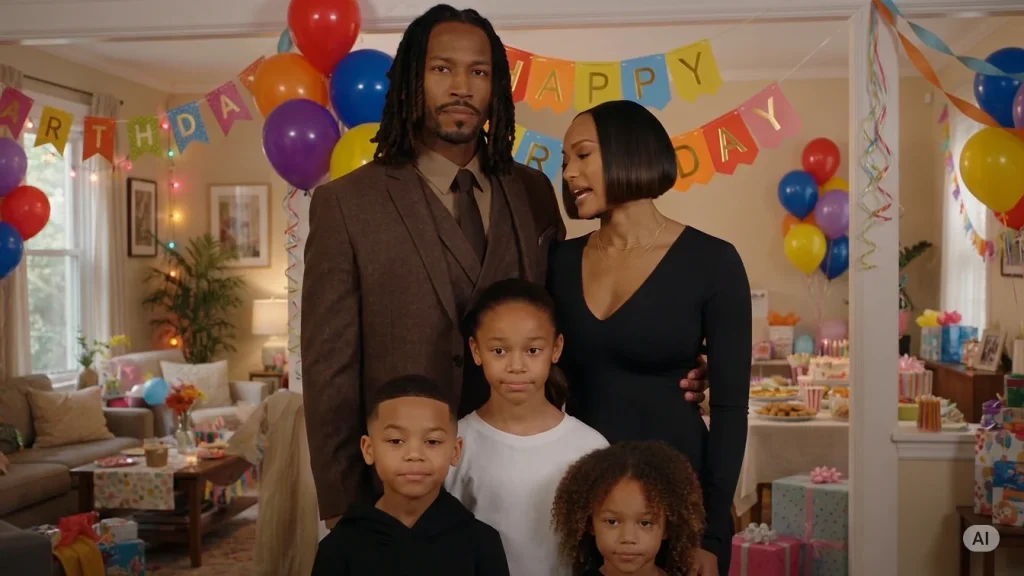
The Birthday Photo Had Room for Five, Until Somebody Started Counting
The banner went up crooked the first time, and Theo Langston took it down and hung it again, because his daughter Josie was turning six and she had asked him, very seriously, to make the letters “go straight like a road.”
HAPPY BIRTHDAY, it said, in fat silver letters strung across the beige wall of the living room, above the long sofa that had been pushed back to make space. Under it, balloons in red and blue and yellow and green bobbed against the ceiling, their ribbons hanging down like the tails of kites. Somebody had tied a cluster of them to the arm of the recliner. Somebody else had let one go, and it rested against the light fixture, turning slowly whenever the front door opened.
Theo stepped back off the folding chair and looked at the banner. It was straight. He was pleased with himself in the small, private way he was pleased when a student finally understood why a war had started.
He was thirty-eight that spring, a history teacher at Larkspur Ridge High School, tall and lean in the shoulders, with long dreadlocks that fell past his collar and a neat mustache that ran down into a short goatee. He wore a brown three-piece suit, the vest buttoned, a light brown shirt under it and a dark brown tie knotted close at the throat. His wife had laughed at the suit that morning. It was a child’s birthday party, she said. There would be frosting on everything by three o’clock.
Theo had only smiled. His father, Clarence Langston, had worn a suit to every birthday Theo could remember, even the ones held in a church basement with paper plates and a sheet cake from the grocery store. When Theo had asked him why, at nine or ten, his father had said, “You dress up for the people you love, son. So they know you noticed the day.” Clarence had been gone for four years now. Theo still dressed up.
Josie was at the head of the loop. She was six years old as of seven-fourteen that morning, a fact she had announced to everyone who came through the door. Her hair was a huge, glorious cloud of curly brown, so full that it made her small face look even smaller, and she wore a long-sleeved shirt with black and grey stripes that she had chosen herself because, she said, it looked like a zebra and zebras were the best animal. Her brother Miles ran behind her. He was seven, solid and serious, with his hair cut short and a black hoodie zipped all the way up to his chin even though the room was warm. He was not trying to catch Josie. He was guarding her, the way he guarded everything, with a frown that made him look like a small security officer.
And behind Miles, slower, came Naomi.
Naomi was eleven. She was light-skinned, with freckles across the bridge of her nose and grey-green eyes that had come from her mother, and her hair was pulled back so tightly from her forehead into a low bun that it seemed to lift the corners of her eyes. She wore a plain white T-shirt and jeans. She had not dressed up. Theo had noticed this when she came downstairs, and he had almost said something, and then the doorbell had rung and his mother-in-law had arrived and the moment had passed, the way so many moments passed in that house.
Naomi was not running the loop. She was walking it, a few steps behind her brother, with her hands half out at her sides, ready. When Josie took the corner into the hall too fast and her socks slid on the hardwood, it was Naomi who caught her by the back of the zebra shirt before her head met the doorframe. She did it without looking surprised, as though she had been expecting it for three laps.
“Nomi,” Josie said, breathless and delighted, as if her sister had performed a magic trick.
“Shoes,” Naomi said. “I told you. Socks are slippery.”
“I don’t want shoes. It’s my birthday.”
“It’s your birthday and it’s still slippery.”
Theo watched them from the doorway of the living room and felt the warmth that always came over him when he saw the three of them together. He had never had siblings. He had never known what it might look like, the shorthand, the nicknames, the bodies that knew where the other bodies would be.
“She’s going to break her neck,” said a voice behind him.
He turned. His wife, Simone, stood with a tray of cupcakes balanced on one hand. She was thirty-five, small and fine-boned, with a sleek black bob cut to the line of her chin, so precise that it seemed to have been cut with a ruler. She wore a fitted long-sleeved black dress with a V neck and three thin gold necklaces layered at her throat, each catching the light at a different height. She was, Theo had always thought, the most put-together person he had ever met. Even at seven in the morning with a sick child on her shoulder, Simone looked as though she had planned it.











