Forty Years at Sea, and the Admiral Had Never Once Left a Stage
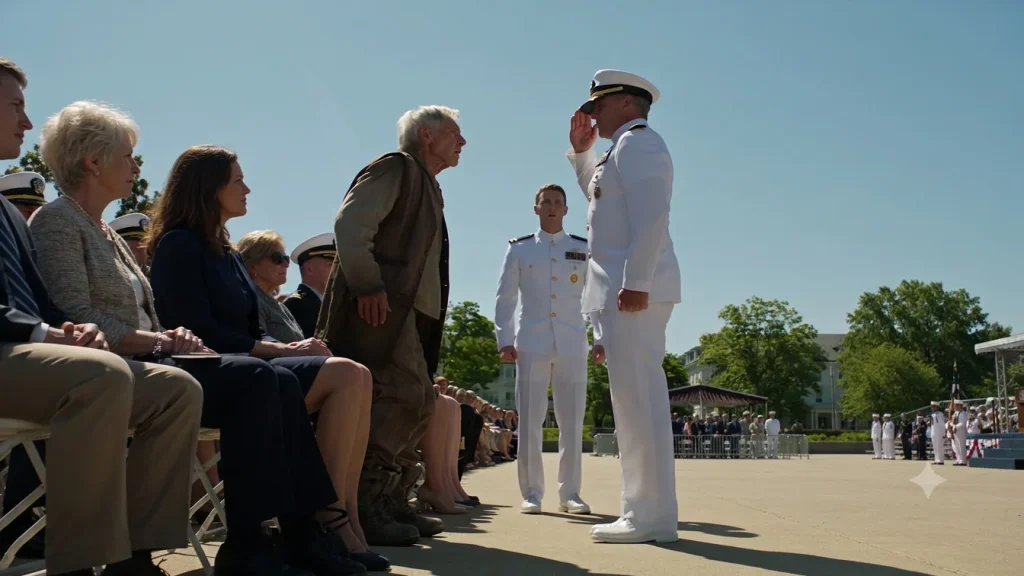
Admiral Richard Callahan sat on the dais in dress whites with his hat on his knee and his hands folded over it. He was sixty-two years old, tall and long in the bone, with white hair cropped close to a skull that had been sunburned on every ocean the Navy sailed. His face was lined the way a chart is lined, carefully and all over. His eyes were a pale, washed blue under heavy brows, and the midshipmen who had served under him on summer cruises said he could look at a man and know what he had eaten for breakfast.
He had spent forty years at sea. He had stood on bridges in weather that bent steel railings like grass. He had made decisions in the middle of the night, with a cup of cold coffee in his hand, that would decide whether hundreds of sailors slept in their racks or in the water. He had come under fire twice and been in a typhoon so bad that the ship’s cook had prayed out loud over the intercom. He believed, as most old officers come to believe, that there was nothing left in the world that could surprise him.
The plaza in front of him was white and blue and gold. Nine hundred and twelve graduating midshipmen sat in rows of folding chairs, their covers tucked under their arms, their faces scrubbed and young and not quite able to hide their joy. Behind them rose the families, thousands of them, on bleachers and on chairs set out across the lawn: grandmothers in sun hats, fathers with cameras, little brothers in clip-on ties who had already loosened them. Beyond the families the harbor glittered, and beyond the harbor lay the open sea, as blue as a flag.
Now came the names. Nine hundred and twelve of them. He settled in to listen.
That was when he looked past the families and saw the man in the battered boots.
He sat alone in the very last row, behind all the proud families, on a folding chair set a little apart from the others, as if he had carried it there himself and did not want to crowd anyone.
He was not dressed for a graduation. He wore a canvas work jacket faded to the color of sand, its cuffs gone soft and frayed, and a gray shirt buttoned to the throat. His trousers had been pressed, but long ago. His boots were the kind men wear on a dock or a deck, cracked across the toes, the laces knotted where they had broken. His shoulders were bent forward, not with age exactly, but in the way of someone who has carried something heavy for a very long time and has forgotten how to stand without it.
His face was weathered dark by wind and sun. He had a short gray beard, more stubble than beard, and his hair was the same gray and cut by someone who did not care much how it looked. A pale scar ran through his left eyebrow and split it in two.
Then the stranger did a small thing. The sun was hot, and he pushed up the sleeve of his jacket to cool his arm.
On the inside of his right forearm, faded almost to the color of a bruise, there was a tattoo. A trident, its three points upright, and wrapped around the shaft from bottom to top, a black vine with small black thorns.
Callahan’s hands went cold on the brim of his hat.
He knew that mark. Almost no one alive knew that mark, and he did.
The men who wore it had called it the Ghost Trident. It did not appear in any book about the Navy. There was no display case in any museum that held it, no patch, no pin, no line in any official history. It belonged to a small detachment that had not, on paper, existed, to operations whose reports were sealed in rooms Callahan had been inside only twice in his life, and to sailors whose names had been taken out of nearly every record that might have held them. The men of the detachment had put it on their arms themselves, in a back room in a port city, with a borrowed needle and a bottle of ink, because they knew that if they died no one would ever carve their names anywhere.
Callahan knew the mark because a man who wore it had once saved his life.
And Callahan had watched that man disappear.
“Ensign…” the Master of Ceremonies announced, and read another name.
The applause rose under the bright coastal sky, rolling across the plaza like surf. Callahan barely heard it. Something inside him had come loose, and he was falling backward through twenty-four years.











