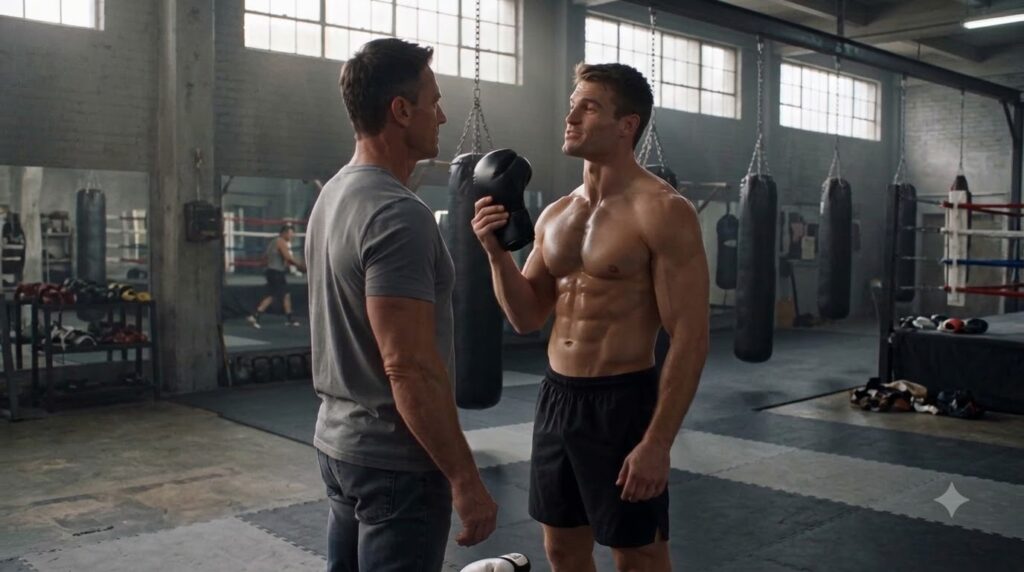
The light came into Ferris Boxing Club the way it had come in for sixty years, through windows so tall and so cut up by iron grid panes that the sun landed on the mats in squares, like somebody had laid a chessboard over the floor and forgotten to take it back.
It was eleven in the morning on a Tuesday. The heavy bags hung from their chains in a long black row, still swinging a little from the last man who had used them. The mats were black and grey, the interlocking kind, and where they met there were seams packed with forty years of chalk and sweat and dust that no mop would ever reach. The whole place smelled like leather and bleach and the river, which was two streets over and never let anybody forget it.
Nina Sorell had been shooting since nine.
She was thirty, with long brown hair she kept forgetting to tie back, a plain black T-shirt, black jeans with the knees gone pale, and no makeup except a smear of balm on her lips that had worn off an hour ago. She held her camera the way some people hold a cup of coffee in winter, close to the chest, both hands, as if it gave off heat. She had a second body slung across her back on a strap and a lens bag clipped to her belt, and she moved around the gym in soft-soled shoes without making a sound on the mats.
She was not there for the fighters. That was the funny part. Everybody assumed she was.
She was there for the hands.
The project was called The Weight of Hands, and it would hang in the Gantry Street Gallery in March, forty prints, black and white, large. Welders. A woman who had braided hair in the same chair for thirty-one years. A harbor pilot. A man who tied fishing flies with fingers so thick it seemed impossible. And, because the gallery’s director had asked for something “with a little more muscle,” three weeks inside the oldest boxing gym in Halvern.
She had brought her old drawing teacher with her. That was the other funny part.
Dell Harlan sat on the low wooden bench under the windows with a sketchbook open on his knee and a stick of charcoal between two fingers. He was fifty-three. He was lean in the way of men who had never stopped moving, not bulky, not soft, with a fitted grey T-shirt that showed shoulders still squared off like a doorframe and forearms roped with old veins. Dark jeans. Black work boots. His hair was cut short and had gone mostly grey at the sides, darker on top. His face was long and serious, the cheekbones high, a faint flattened place on the bridge of his nose that you only saw if the light hit it from the side. His eyes were a pale, washed brown and they did not move much. When they did, they moved all at once.
He had not said anything in forty minutes.
He was drawing the young man on the heavy bag.
The young man was Brody Kincaid, and Brody Kincaid did not like being drawn.
He was twenty-five. He was enormous through the chest and shoulders, built the way the newer fighters were built, with a kind of sculpted thickness that came from a nutrition plan and a strength coach and a phone full of recorded workouts. He was shirtless, in black athletic shorts with the waistband rolled once, and his skin shone with sweat from his neck to his navel. His hair was dark, cropped close on the sides and left longer on top, and he had pushed it back with one wrapped hand so many times it stood up in a ridge. He had a strong jaw and a wide, easy smile, and he used the smile the way he used his jab, often, and to see what it bought him.
He was fifteen and oh. He had a regional title fight in seven weeks with the Castellan Boxing Association, and he had a manager named Curtis Vane who stood over by the ring ropes holding a phone sideways, filming everything, because Curtis Vane believed that if a thing happened and nobody posted it, it had not really happened.
Brody hit the bag six more times, hard, and then stopped and let it swing, and turned around.
“You drawing me, old man?”
Dell’s charcoal kept moving. “Trying to.”
“How’s it look?”
“Like a man hitting a bag.”
Curtis laughed behind his phone. Brody didn’t.
He walked over. He had unwrapped one hand on the way, and he carried one black boxing glove by the cuff, the way you’d carry a dead bird you’d found on the porch. Somebody had left a pair of old white gloves lying on the mat in the square of sunlight between the bench and the bags, laces trailing, and Brody stepped over them without looking.











