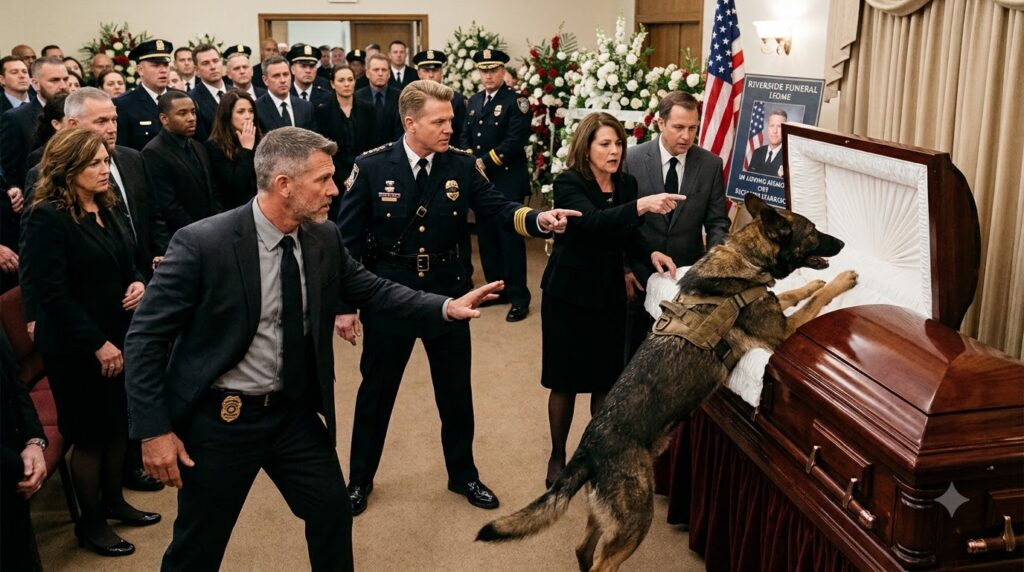
The German Shepherd’s bark pierced the solemn quiet of Riverside Funeral Home like a siren in the night.
Max stood rigid, hackles raised, his powerful body trembling as he stared at Chief Richard Harrison’s mahogany coffin. His desperate barks echoed off the walls, drowning out the minister’s prayers and the muffled sobs of the bereaved.
“Someone get that damn dog out of here!” hissed Deputy Chief Parker, his face flushed with anger. “Show some respect!”
Detective Michael Carson watched as two officers attempted to drag Max away, but the dog broke free, plunging toward the coffin with such force that the floral arrangements toppled. The mourners gasped. Sarah Harrison, the chief’s widow, covered her mouth with trembling hands.
Max’s behavior wasn’t just grief. Carson had seen the dog at countless death scenes. This was different. The animal wasn’t mourning. He was alerting.
When Max suddenly launched himself at the coffin, tearing at the silk lining with his teeth, chaos erupted. As hands reached to restrain him, Carson stepped forward, a cold realization washing over him.
“Wait,” he commanded, raising his hand. “Open it. Open the coffin now.”
In the stunned silence that followed, only Max’s persistent growls could be heard. What happened next would haunt everyone present for the rest of their lives.
Detective Michael Carson had spent 23 years with the Riverside Police Department, 15 of them under Richard Harrison’s leadership. At 46, Carson’s weathered face told the story of a man who’d seen too much, the creases around his eyes deepened by both laughter and grief, his salt-and-pepper hair cropped military short, his blue eyes retaining a sharpness that missed nothing.
Three years ago, Carson had lost his wife, Emma, to ovarian cancer, leaving him alone in a house too big and too quiet.
What most of Riverside didn’t know was that Carson’s connection to Chief Harrison went back much further than his police career. As a troubled 16-year-old caught breaking into the corner market, Carson had encountered Officer Harrison, who saw something worth saving in the angry young man.
Instead of processing him through the system, Harrison had taken him home for dinner, introduced him to Sarah, and over meatloaf and mashed potatoes offered him a deal: community service and weekly check-ins instead of juvenile detention.
That night changed Carson’s life trajectory forever.
“You’ve got good instincts, son,” Harrison had told him years later, when Carson made detective. “Trust them, even when everyone tells you you’re wrong.”
Chief Richard Harrison had been a fixture in Riverside for over 30 years. At 58, he still cut an imposing figure, 6’2″ with broad shoulders and a military posture that commanded respect without a word. His steel-gray hair and trimmed beard framed a face known for fairness and integrity. The wrinkles around his eyes spoke of someone who smiled easily, but could turn deadly serious in an instant.
Harrison and his wife Sarah had no children of their own, though they’d informally adopted countless troubled youth over the decades. Their childlessness wasn’t by choice. Sarah had suffered three miscarriages early in their marriage. Instead, they poured their nurturing instincts into their community and into Max, the German Shepherd who’d been Harrison’s partner before retiring to become their family pet.
Max had come into Harrison’s life seven years ago during a warehouse raid that went wrong. The drug bust had triggered an explosion that killed Max’s handler and left the dog badly injured. Harrison had stayed with Max throughout his recovery, and the bond formed couldn’t be broken. When Max was deemed unfit to return to active K9 duty due to hearing damage in one ear, Harrison had brought him home permanently.
Sarah Harrison was her husband’s equal in compassion, but possessed a quiet strength all her own. At 56, her auburn hair now streaked with silver, she’d taught third grade at Riverside Elementary for 28 years. Her students, past and present, filled three rows at the funeral, clutching handmade cards and tissues.
Deputy Chief William Parker had been Harrison’s second-in-command for eight years. At 49, his ambition was an open secret in the department. Trim, meticulous, with carefully maintained blonde hair and a politician’s smile, Parker had always been respected, but never loved like Harrison.
Dr. Elizabeth Miller, the county medical examiner, stood apart from the mourners, her analytical gaze moving between the coffin and Max. At 38, she was relatively new to Riverside, but had quickly earned a reputation for thoroughness. Something about the chief’s death report had bothered her from the beginning.
Riverside itself was changing. Once a peaceful manufacturing town of 75,000, it had been hit hard by factory closures in recent years. A growing opioid crisis had transformed certain neighborhoods, bringing violence and desperation. Chief Harrison had been leading a major investigation into a trafficking ring that reached surprisingly high into Riverside’s power structure, or so the rumors went.











