The sign-up sheet had one line on it, and somebody had already written a name in pencil.
TANNER V.
That was the name.
It was written in the careful, slanted capitals of someone who expected to be believed.
Under it, in blue ballpoint, pressing hard enough to dent the cork behind the paper, Frankie Szymanski had written her own.
FRANCESCA DOMBROWSKI. 9TH. BASS.
She had thought about writing just FRANKIE.
She had decided that FRANKIE looked like a person who might not show up.
So she had written the whole thing, all eighteen letters of it, and then the grade, and then the instrument, in case anybody was confused about why a freshman would sign a sheet that said SPRING SHOWCASE ENSEMBLE — BASS — OPEN CALL — THURS 3:15 BAND RM.
Nobody was confused.
They just weren’t expecting it.
That was a different thing.
Frankie would spend a lot of years learning the difference.
The band room at Harlow Valley High School was the oldest room in the building, because the band room was the only part of the old school they hadn’t knocked down in 1994.
Everybody said it was because of the floor.
The floor was maple, laid in 1931, a long honey-colored field of narrow boards that had been scuffed by sixty years of marching shoes and then sanded and then scuffed again.
The windows went almost to the ceiling.
Tall ones, old ones, with wavy glass in the top panes that made the parking lot look like it was underwater.
In the afternoon, the sun came through them sideways and lay down across the floor in long gold bars, and every speck of dust in the room lit up and drifted around like it had somewhere better to be.
There were chairs stacked against the back wall.
There were music stands, black, folded, leaning like tired people.
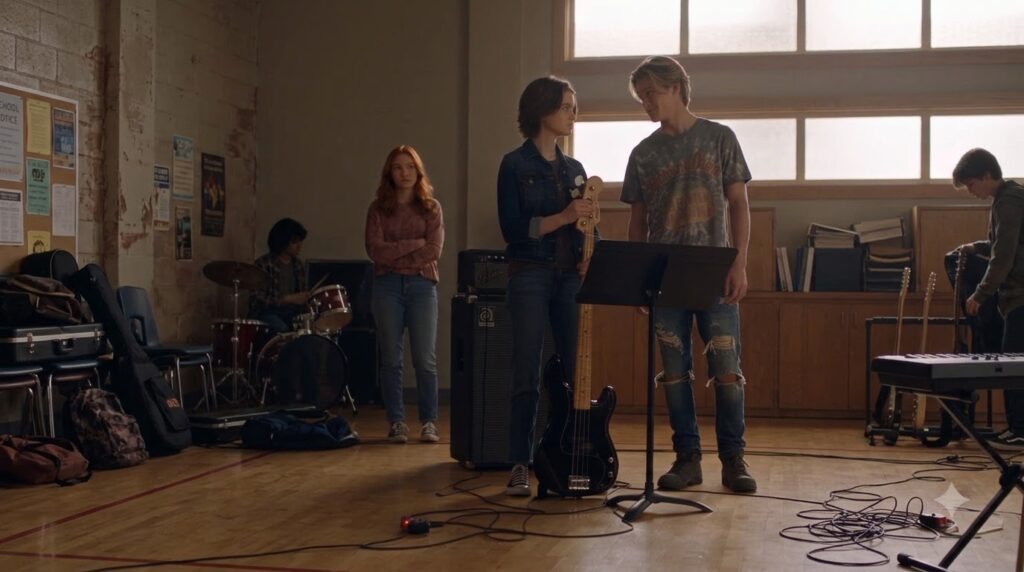
And near the windows, on a square of carpet somebody had rolled out to protect the maple, there was the rig.
Two amplifier cabinets stacked one on the other, black, scuffed at the corners, with a head on top that had more knobs than seemed medically necessary.
A drum kit, silver, the bass drum head painted with a lightning bolt that someone had started and not finished.
A keyboard on a stand.
Cables.
So many cables.
Black ones, gray ones, one orange extension cord taped to the floor with blue painter’s tape and then retaped with silver duct tape and then, finally, by somebody who had lost all hope, with a band-aid.
At 3:14 on Thursday, Frankie stood in the doorway of that room with her bass.
She was fourteen.
She was, depending on the shoes, five foot one.
She had a short brown bob that her mother cut in the kitchen every eight weeks with a comb and a pair of scissors that were not, technically, for hair.
She wore a jean jacket that had been her Uncle Gil’s in the eighties and still smelled faintly of his old car, which was not a compliment to either the jacket or the car.
The jacket had patches.
A railroad crossing sign.
A cartoon lightning bolt.
A round one from the Linden Junction Volunteer Fire Company Fish Fry, which she had not attended but which her grandfather had, and which he described as a turning point.
Under the jacket, a dark tee.
Jeans.
Checkered sneakers with the checks worn gray at the toes.
And the bass.
The bass was black.
It had a maple neck the color of the floor, which she liked, because it made her feel like the room had been expecting her even if the people hadn’t.
It had four strings and one dent and a pickguard that had been cracked and glued and was holding together on what her uncle called “faith and a little epoxy.”
She held it upright beside her, the way some people hold a flagpole, with the body resting on the toe of her sneaker so it wouldn’t touch the floor.
She did not have a case.
She had a pillowcase.
The pillowcase was at home.
She had decided, on the bus, that walking into the band room with a bass in a pillowcase was a different audition than walking in with a bass, and that she could only afford to take one of them.
So she had carried it bare, through the main hall, past the trophy case, past the vending machine that ate dollars, past a group of sophomores who had said, “Is that real?” and then laughed at their own question as if it had been somebody else’s.
“It’s real,” she had said.
She had not stopped walking.
There were three people in the band room.
There was a girl behind the drum kit.
Not sitting at it.
Standing behind it, off to the left, with her arms crossed.











