The bus knelt at every stop.
That was the first thing Sol Quintero ever learned about rhythm, though she did not know at the time that it was rhythm.
She thought it was just the bus.
The Route 14 bus, number 6142, pulled up to the curb, sighed like an old man lowering himself into a chair, and tipped its whole front end down toward the sidewalk so nobody had to climb.
Hsssss.
Then the doors.
Ka-chunk.
Then the fare box, which beeped twice if you paid and once if you did not, and once, angrily, if you tried to pay with a bus pass that had gone through the wash.
Then the doors again.
Then the long hiss back up.
Then the blinker.
Tick. Tick. Tick. Tick.
Then the pull away from the curb, the engine climbing up its own throat, and somewhere behind the third window on the left, the loose pane that rattled every single time the bus went over the seam in the road at Delmar and Fifth.
Brrrap.
Sol was seven when she first noticed that the rattle at Delmar and Fifth came on the same beat every time.
She was eight when she noticed that if she counted from the kneel to the rattle, it was always the same number, unless it was raining, or unless Mr. Abernathy got on with his walker, in which case it was longer and nobody minded.
She was nine when she started playing along.
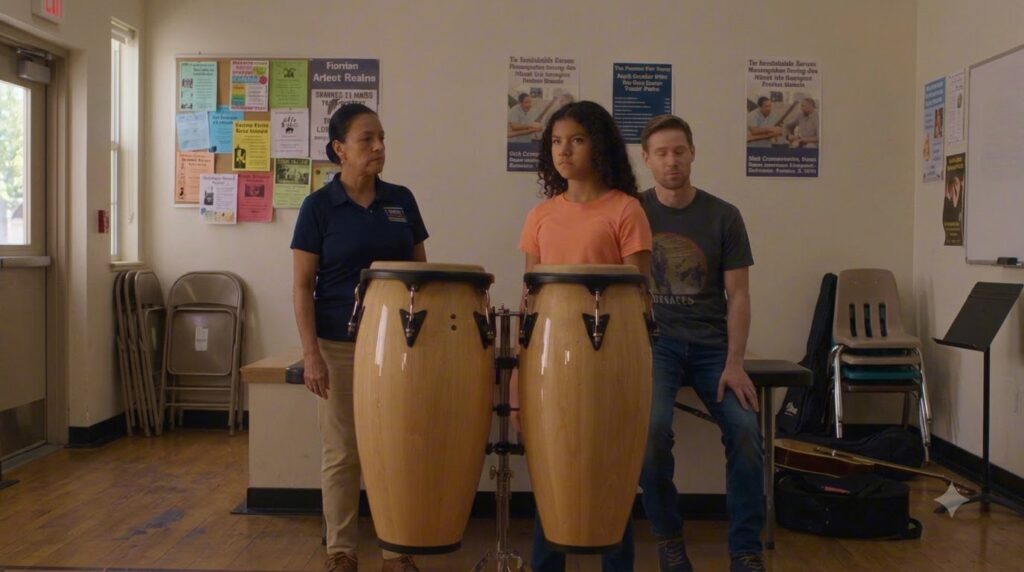
She was eleven, and she had been playing along for two years, every Saturday and most Sundays and every day of every summer, when she walked into the multipurpose room of the Ferrell Park Community Center with her hands in her pockets and her heart in her teeth and saw, for the first time in her life, a pair of real congas.
But that was later.
First, the bus.
Her mother drove it.
Inés Quintero had driven for the Calvera Regional Transit Authority for fourteen years, the last nine of them on Route 14, which ran from the Ocampo Street depot out through Ferrell Park, past the hospital, past the swap meet, past the long brown nothing of the old rail yards, all the way out to the end-of-line turnaround at Bellwood Plaza, where there was a bench, a trash can, a payphone that had not worked since before Sol was born, and nothing else.
Then it turned around and came back.
Fifty-six minutes out.
Fifty-six minutes back.
Eleven-minute layover at each end, if the schedule was being honest, which it usually was not.
“The schedule,” Inés liked to say, “is a work of fiction based on a true story.”
Inés was short and solid and had a voice that could cut through a full bus at rush hour without being raised, which was a skill she said she had learned from her own mother, and which her own mother said she had learned from God, and possibly from raising five children in a two-bedroom house with one bathroom.
She wore her hair in a tight bun under her transit cap.
She wore reading glasses on a beaded chain that Sol had made her in the third grade, which had too many purple beads in it and one bead shaped like a frog.
She never took it off.
“It’s my good luck frog,” she told passengers who asked.
“Does it work?”
“I’ve never been in an accident.”
“Have you ever been in an accident before you had the frog?”
“I’ve never been in an accident.”
Which was, the passengers usually decided, an answer.
Sol rode the bus because there was nowhere else for her to go.
That was the plain fact of it, and nobody in the family pretended otherwise.
Her father, Hector, worked nights at the Valle Grande commercial bakery out by the freeway, ten at night until six in the morning, loading racks of rolls into ovens the size of garages. He came home smelling like bread and burnt sugar and slept until two in the afternoon with a towel over his eyes and a box fan going full blast, and nobody, not even the dog, was allowed to wake him.
There was no dog.
But if there had been, it would not have been allowed.
Her abuela, Chayo Arce, her mother’s mother, lived with them and would have watched Sol, except that Abuela Chayo’s knees had gone bad and her eyes had gone worse and she had also, three years earlier, been put in charge of Sol’s little brother Nico, who was six now and had been, since birth, what Abuela Chayo called un terremoto.
An earthquake.
“I can watch one child,” Abuela Chayo said. “I cannot watch an earthquake and a child at the same time. One of them is going to fall into something.”











