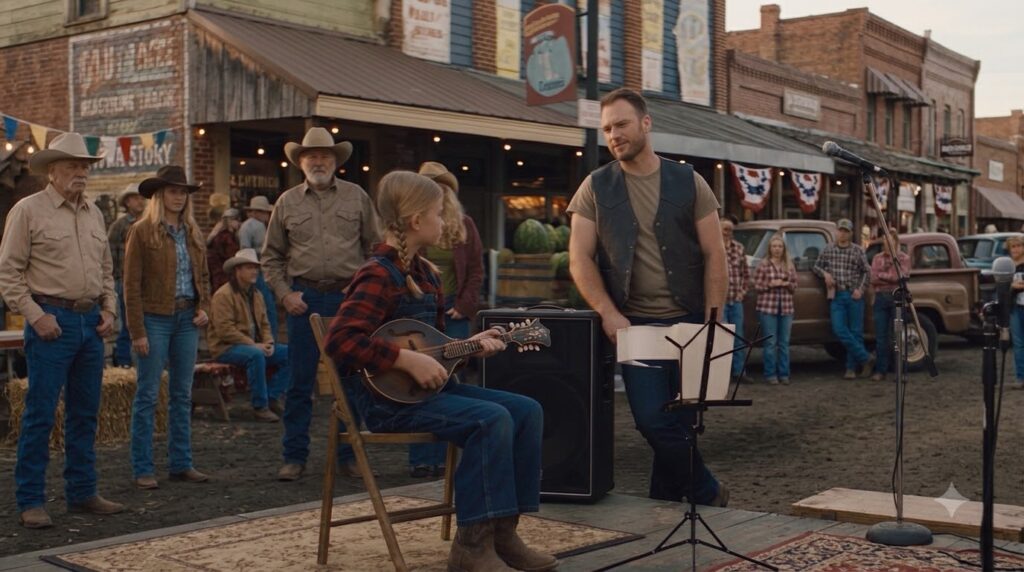
“That’s a Toy, Kid,” the Man by the Post Said
The mandolin cost forty-one dollars and a hair dryer.
The forty-one dollars came out of a coffee can.
The hair dryer came out of Aunt Lacey’s bathroom, and Aunt Lacey did not find out about it until the following spring, when she went looking for it before a wedding and found, in its place, a note.
The note said: I.O.U. one hair dryer. Love, Josie. P.S. It was a trade.
Aunt Lacey kept the note.
She said it was evidence.
Josie Penner was eleven years old on the Thursday she sat down on the plank stage under the tin awning at Brandt’s General Store.
Eleven years and two months, if anybody was asking.
Nobody was.
That was most of the problem.
The Cutler’s Ford Thursday Market ran from four o’clock until the light went, May through October, in the gravel lot beside Brandt’s, which had been a general store since 1911 and looked it.
The building was old red brick gone soft at the corners.
Painted on the side, in letters as tall as a man, were three faded banners from three different decades.
FEED & SEED, said the oldest, in white that had gone the color of milk tea.
BRANDT’S — EVERYTHING BUT THE KITCHEN SINK, said the middle one, and under it, in smaller letters someone had added later, WE HAVE SINKS NOW.
The newest one just said OPEN, and it was the most faded of the three, which Wanda Brandt said was a metaphor, though she never said for what.
Along the front of the store ran a tin awning on cedar posts.
Under the awning, somebody had strung white bulbs.
Not fancy ones.
The kind sold in a box at Christmas, the box saying INDOOR/OUTDOOR in a tone that suggested it would rather not be held to it.
At dusk the bulbs came on, and the brick went orange, and the whole lot looked like something a person would remember later, even if, at the time, they were mostly thinking about tomatoes.
There were tomatoes.
There were crates of watermelons stacked three high by the porch steps, striped and dull and heavy, with a cardboard sign that said $5 OR TWO FOR $9 DON’T THUMP THEM.
People thumped them.
There were sweet corn and green beans and a man who sold honey out of the back of a station wagon and talked about his bees by their individual names, which was either very charming or a sign of something, depending on who you asked.
There was a woman who sold jam with labels so small you needed reading glasses to tell the peach from the pepper.
There was a kettle corn tent that smoked like a train.
And at the east end of the awning, in front of the big plate window that still said BRANDT’S in gold leaf, there was the stage.
It was not much of a stage.
It was eight sheets of planking on cinder blocks, about a foot off the ground, built by Wanda’s late husband, Orville, in a single afternoon in 1994, and never improved since, because, Wanda said, Orville had done it right the first time and she wasn’t going to insult him.
There was a rug on it.
A braided oval rug in browns and rusts and one strip of green, which had been in Orville’s mother’s front room and had seen things.
There was a wooden folding chair.
There was a black amp speaker on a short stand, the kind with a metal grille and a knob that went to eleven, which sounded impressive until you learned that the knob went to eleven because somebody had peeled off the 10 sticker and drawn an 11 on with a marker.
And there was a music stand.
Black wire, folding, one leg slightly shorter than the other two, so that it always leaned a little to the left, as if listening for something.
The stage was called the Porch.
Every Thursday at seven, somebody played on the Porch for an hour.
Usually it was somebody from around.
The Gaffney Brothers, who were not brothers, played bluegrass on the first Thursday of the month.
A retired mail carrier named Hollis Tate played harmonica and told the same three stories, in the same order, every time, and people came specifically to hear him get to the third one.
A youth pastor’s wife played the autoharp once in a way nobody ever fully recovered from.
It was free.
You sat on hay bales or the tailgate of your own truck, or you stood with your corn in a paper sack and listened for a while, and then you went home.
Wanda said it was the best thing about the market, better than the tomatoes.
The tomato people disagreed, but they also came every week to listen.











