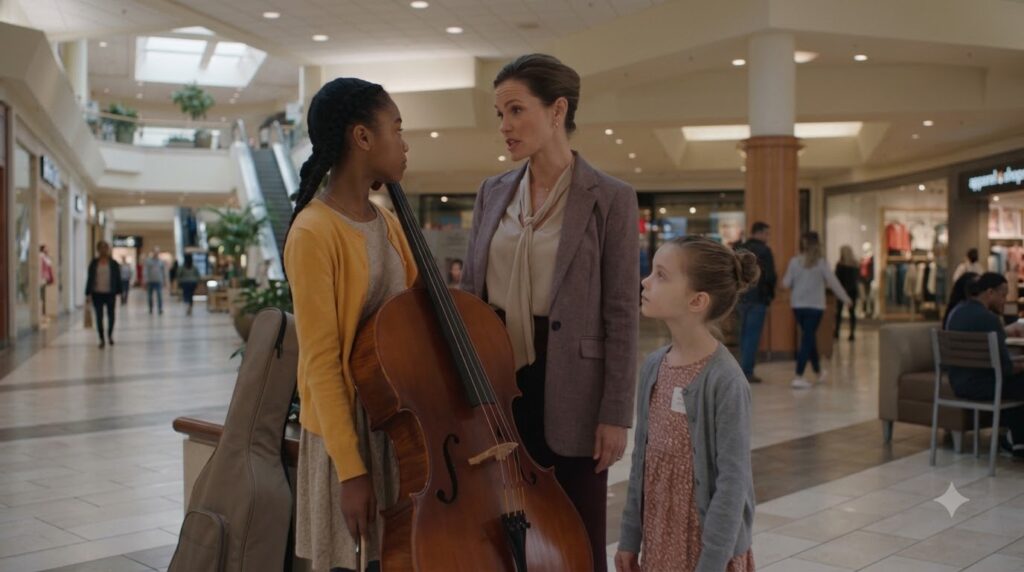
Nobody at Harrowgate Commons asked twelve-year-old Ruby Lattimore whether she could play the cello.
They asked where her mother was.
Then they asked her to get up.
The chair was not special.
It was a black folding chair with a padded seat, the kind that lives by the hundreds in storage rooms and comes out for weddings, funerals, and anything a building wants to call an event.
Somebody had set it in the center of a low carpeted riser in the main atrium of Harrowgate Commons, the largest shopping mall in Larkfield, Ohio.
Beside it stood a music stand.
In front of it, a single microphone on a short boom.
Behind it, a forty-foot artificial spruce wrapped in white lights and silver ribbon, rising past the second level and nearly touching the glass ceiling.
To the left, the fountain.
To the right, the escalators.
Above it all, a banner that said, in looping gold script:
WINTER STRINGS IN THE ATRIUM.
Under that, smaller:
Local Music. Local Hearts.
Ruby had read the banner six times since nine-fifteen.
She had read the smaller line eight times.
She did not trust the word hearts on a banner.
It seemed like a word people used when they had run out of better ones.
But she understood the general idea.
Local music.
She was local.
She lived eleven minutes away by the number 14 bus, fourteen minutes if the driver was the one who stopped to talk to everybody, and twenty-two minutes if it was snowing, which in Larkfield in December was a question of when, not whether.
She was also, according to a printed schedule taped to the back of the riser, the music.
10:30 AM — Ruby Lattimore, cello.
Original composition.
That was her.
That was her name in a font somebody had chosen.
She had looked at it so long the letters had stopped looking like letters.
She was twelve years and eight months old.
She was wearing a dark green sweater her grandmother had knitted two winters ago, slightly too short in the sleeves now, black pants, black shoes that pinched, and a puffy gray coat she had already taken off and folded over the back of the chair because her teacher said nobody plays well in a coat.
Her hair was pulled back in two puffs because her mother said, and Ruby quoted, “If it’s in your face, you’ll fuss with it, and if you fuss with it, you’ll be the girl who fussed with her hair instead of the girl who played.”
Her cello case stood upright beside her.
It was a hard case, dark blue, with one dented corner and a strip of silver duct tape across a crack in the shell near the bottom.
The duct tape was not decorative.
The case had fallen off a bus bench in February.
The cello inside had survived.
Ruby’s dignity had taken longer.
She had arrived early because her mother worked at Harrowgate Commons.
Not in a store.
Under the stores.
Around them.
After them.
Denise Lattimore was a lead custodian on the overnight and early-morning crew.
She drove the big ride-on floor scrubber that came out after closing and moved through the empty corridors like a slow, wet, humming whale.
She knew which planters the teenagers threw cups into.
She knew which escalator squealed on the third step.
She knew that the fountain had to be skimmed twice on Saturdays because people threw in coins and also, inexplicably, French fries.
“Why French fries?” Ruby had once asked.
“Wishing on a budget,” her mother said.
Denise’s shift had ended at seven that morning.
Normally she would have gone home and slept until two.
Instead she had gone to the break room in the service corridor behind the food court, drunk a cup of coffee strong enough to wake furniture, changed into jeans and a sweatshirt, and come back out to the atrium to sit on the edge of the fountain and wait for her daughter to play.
At nine-forty she had been called back.
A pipe under a sink in the second-floor family restroom had decided to become a river.
“Twenty minutes,” Denise said.
“Okay.”
“Do not go wandering.”
“I’m not going to wander.”
“Do not go into the candle store and smell everything until you get a headache.”
“That happened once.”
“It happened four times.”
“Each time was different.”
Her mother pointed at the riser.
“Sit there. Breathe. Be a cellist. I’ll be back before you’re on.”
“You promise?”
“I promise. The pipe doesn’t.”
Then she was gone through the gray door marked STAFF ONLY next to the restrooms, and Ruby was alone in the atrium with her cello, her printed name, and a tree.
That was all right.
Ruby was used to being alone in that building.
She had been coming to Harrowgate Commons almost every weekend since she was six.











