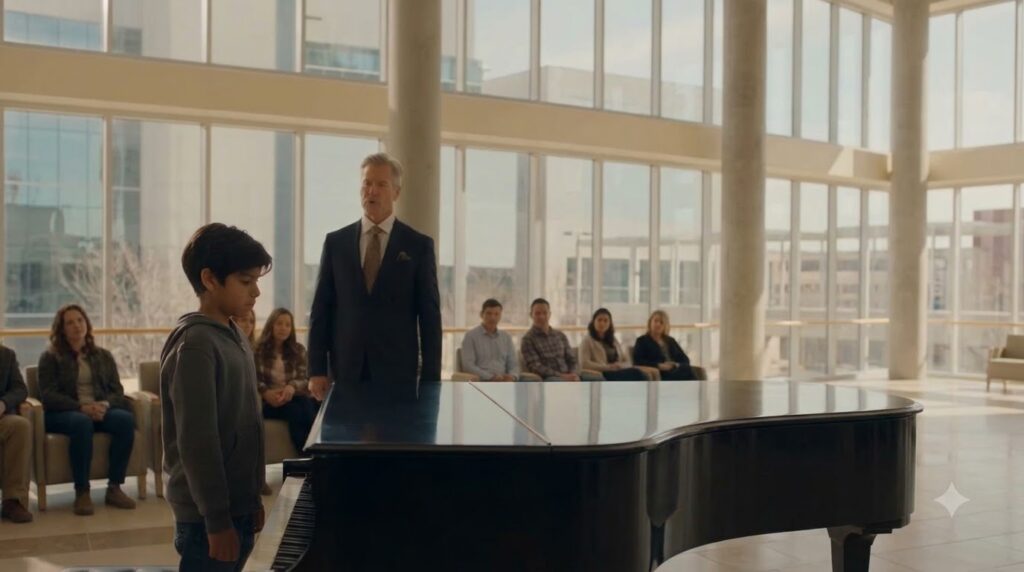
At first, nobody asked thirteen-year-old Owen Mercer whether he could play the piano.
They asked him whose kid he was.
Then they asked him to move.
The piano stood in the main atrium of Bramwell General Hospital in Pittsburgh, under three stories of tall glass windows that faced the river and caught the morning light before anything else in the building did.
It was an old black grand.
The lid was scratched.
One leg had a chip in it shaped roughly like Ohio.
A piano technician had tuned it the day before, but tuning could not erase eleven years of public use.
Patients had played it.
Visitors had played it.
Surgeons had played it at the end of eighteen-hour days, badly, with their eyes closed.
Children waiting for news had pounded on it until somebody gently lifted them off the bench.
A respiratory therapist once sat there at three in the morning and played the same lullaby for twenty minutes because, she said later, she had just lost a patient and could not go home yet.
Nobody stopped her.
The piano belonged to nobody important.
That was supposed to be the point.
A small brass plaque was screwed to a stand beside it.
MUSIC BELONGS HERE.
PLAY WITH CARE.
PEOPLE ARE HEALING.
Owen had read those words perhaps a hundred times.
He knew, because he spent most Saturday mornings in that atrium.
His father, Frank Mercer, worked facilities at Bramwell.
Boilers.
Chillers.
Air handlers.
Steam lines.
The ugly, humming, invisible machinery under a hospital that made sure the operating rooms stayed cold and the newborn nursery stayed warm and nobody upstairs ever had to think about any of it.
Frank took weekend overtime whenever it was offered.
It was offered often.
Hospitals do not close on Saturdays.
Neither do boilers.
Owen was not allowed in the mechanical rooms.
Rules.
Liability.
Also, as Frank put it, “One wrong valve and you cook a floor of cardiology.”
So Owen waited upstairs, in the public atrium, with a backpack, headphones, homework, a phone charger, and exactly enough money for two vending-machine pretzels and a chocolate milk.
That was the deal.
He had kept it for years.
The piano had become part of the deal without anybody negotiating it.
At first, he only watched.
He was nine.
He sat on the bench by the gift shop and watched strangers sit down, play something, and leave.
Some were good.
Most were not.
Owen did not care.
He liked that they did it at all.
Then one morning, when he was ten, an old woman in a wheelchair rolled herself up to the keys.
She had a hospital bracelet on her left wrist and a knitted purple hat pulled down over her ears.
A volunteer parked her and left to find a blanket.
She played a hymn.
Slowly.
Her hands were thin and spotted and they shook between phrases but not during them.
When she finished, she noticed Owen staring.
“You,” she said.
Owen pointed at himself.
“Yes, you. The one with the eyebrows.”
He did not know what that meant.
He came over anyway.
“You know where middle C is?”
Owen shook his head.
She took his finger.
Her hand was very cold.
She put his finger on a white key near the center of the piano, just left of two black ones.
“That one.”
He pressed it.
It sounded like a note.
That was all.
“Everything else,” she said, “is just counting from there.”
Her name was Dolores Finch.
She was seventy-nine.
She came for dialysis three mornings a week and was, she informed him, “extremely bored by kidneys.”
The following Saturday, Owen found middle C by himself.
He found it the Saturday after that too.
Mrs. Finch was there twice more.
She taught him a five-note scale.
She taught him that the black keys came in twos and threes so you could never get lost.
Then one Saturday she was not there.
Owen asked the volunteer at the information desk.
The volunteer said, carefully, “She’s not coming in anymore, sweetheart.”
Owen was ten.
He understood more than adults thought.
He went back to the piano.
Found middle C.
Played the five notes.
Then played them again.
By the end of that winter, he could pick out the hymn Mrs. Finch had played.
By spring, he could pick out the song his grandmother hummed while she ironed.
A patient-transport tech named Marcus Bell, pushing an empty wheelchair back from radiology, stopped one morning and showed him three chords.
“C, F, G,” Marcus said. “That’s half of all music ever written. The other half is lying.”
A medical student on break corrected his left hand.
A chaplain explained the pedals.
A security guard named Pete told him, every single week, “Not so loud, the ICU is right up there,” which was not true, but Owen played softer anyway.











