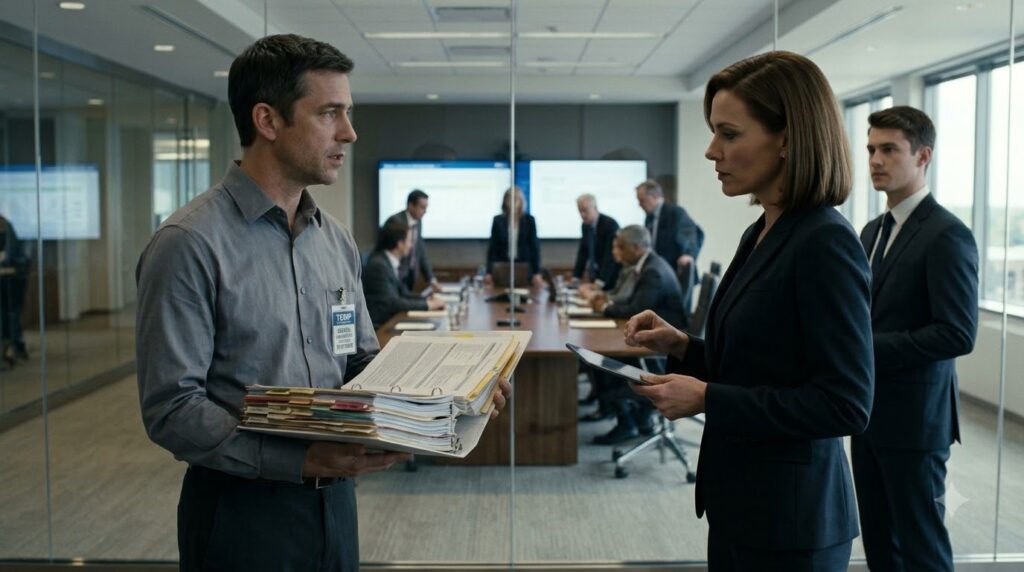
On the morning Vanderrest Systems prepared to sign the largest deal in its history. Celeste Vanderrest looked at the badge hanging on my chest and told me to wait outside. No thank you, no chair, just a sentence pitched loud enough for the entire corridor to hear. “Investors come to meet leadership, not support staff.”
I stepped aside without arguing. 10 minutes later, the elevator opened and Gideon Ashford walked out with his attorneys behind him. He glanced at Celeste, glanced into the conference room, and asked the one question that erased her smile completely. “Where is Nolan Keen?”
The executive floor smelled like cut flowers and furniture polish that Monday, which was how I knew the building had stopped being a workplace and become a stage. Somebody had ordered white lilies for the reception desk, and the long walnut table in the main conference room had been buffed until the overhead lights doubled in it like a second ceiling. Three screens along the far wall cycled a single graphic. The Vanderrest crest beside the Ashford Capital mark, joined by a thin line that somebody in marketing had probably agonized over for a week.
Security had quietly cleared the floor of anyone below vice president. The way a theater clears the aisles before curtain. I was there because the chief operating officer had called me at 6:40 that morning and asked me to carry the final operations binder upstairs myself, since he did not trust a courier with the only complete copy. So I rode the elevator with the complete binder under my arm and no idea I was about to become a piece of furniture that did not match the room.
What made it sting and I want to be precise about this because the sting matters later is that I had written most of what was inside that binder: the deployment histories, the vendor contingency maps, the failure taxonomy, the site-by-site remediation logs going back 31 months. All of it came out of my laptop and my weekends and a thousand phone calls with plant managers in towns nobody on that floor could find on a map. The slides upstairs had been built from my numbers. My charts had been recolored, my captions rewritten, my qualifiers trimmed.
And on the final version of the presentation on the credits page where the contributing teams were listed in six-point type, my name had been removed sometime in the previous 48 hours. I did not learn that in a dramatic way. I learned it standing near a printer, glancing at a discarded proof, the way you learn most things that hurt in an office. Celeste came down the corridor at 8:09 with her assistant half a step behind her and a tablet held like a scepter.
She was 42. She had never in her life been the least prepared person in a room. And she carried the particular confidence of someone whose family name is on the building and who has decided that this fact is a coincidence she has personally overcome. She saw me first as a shape then as a problem.
I watched her eyes move down from my face to the plain gray shirt I had ironed at 11 the night before, then to the temporary executive badge clipped to my pocket, and I could see her doing arithmetic that had nothing to do with the deal. She did not ask me anything. She turned to her assistant and said in a voice that was not lowered at all, “Why is operations staff still on this floor?” I said that the chief operating officer had asked me to be present for the implementation portion of the question period and that Mr. Ashford’s team had submitted 14 technical questions in advance, nine of which touched sites I had personally handled.
It was the longest sentence I said to her that morning. She let it finish, which I later understood was not patience but calculation. And then she explained to the air somewhere above my left shoulder that a firm like Ashford Capital reads a room before it reads a term sheet. If they see a coordinator seated at the table, she said they conclude that this company has no bench.
Optics are not vanity at this level. They are information. She said it the way people say things they have rehearsed in the shower and are pleased to finally deploy.
Then she did the thing I still think about. She was not content to send me down the hall. She looked at the temporary badge on my pocket, the laminated rectangle that had been issued to me at 7 that morning so I could reach the executive floor at all, and she told her assistant to collect it. The assistant, a young man named Peter, who had done nothing to deserve his part in this, hesitated for exactly one second and then held out his hand.











